Table of Contents
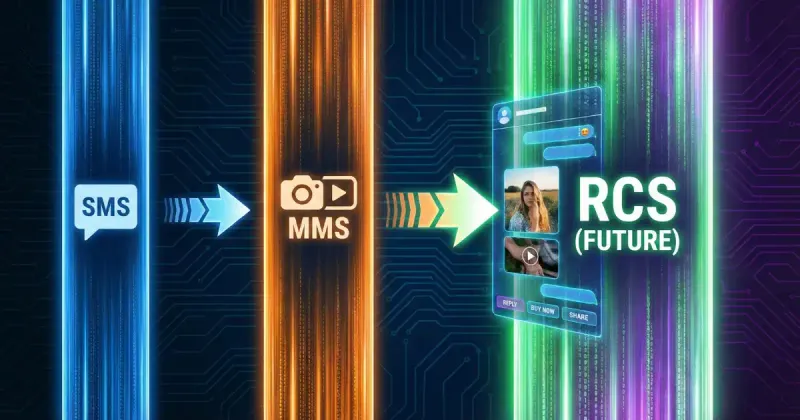
The messaging landscape has evolved dramatically since the first SMS was sent in 1992. Today, businesses must navigate three distinct technologies: SMS, MMS, and the newer RCS. Each serves different purposes, with varying costs, capabilities, and device support.
This comprehensive guide breaks down everything you need to know to choose the right messaging technology for your needs.
Quick Comparison Table
| Feature | SMS | MMS | RCS |
|---|---|---|---|
| Full Name | Short Message Service | Multimedia Messaging Service | Rich Communication Services |
| Year Introduced | 1992 | 2002 | 2008 (widespread 2019+) |
| Character Limit | 160 (GSM-7) / 70 (Unicode) | 1,600 characters | 8,000+ characters |
| Media Support | Text only | Images, audio, video | Images, video, files, carousels |
| Read Receipts | No | No | Yes |
| Typing Indicators | No | No | Yes |
| Group Chat | Basic | Basic | Advanced |
| Requires Internet | No | No | Yes |
| iPhone Support | Yes | Yes | Yes (2024+) |
| Android Support | Yes | Yes | Yes |
| Business Verified Sender | Limited | Limited | Yes (brand logo, verification) |
| Average Cost per Message | $0.01-0.05 | $0.03-0.10 | $0.01-0.03 |
| Delivery Reliability | 99%+ | 95%+ | 90%+ (network dependent) |
What is SMS?
SMS (Short Message Service) is the original text messaging protocol, standardized in 1986 and first used commercially in 1992. It remains the most universally compatible messaging format.
How SMS Works
SMS uses the signaling channel of cellular networks—the same pathway used for call setup. This means:
- Messages transmit even with weak signal
- No data plan required
- Works on any mobile phone (feature phones included)
- Near-instant delivery (typically 3-5 seconds)
SMS Specifications
| Specification | Value |
|---|---|
| Maximum length (GSM-7) | 160 characters |
| Maximum length (Unicode) | 70 characters |
| Concatenation limit | Up to 255 segments |
| Supported content | Text, links |
| Protocol | SS7/SMPP |
SMS Strengths
- Universal reach: Works on 100% of mobile phones
- Reliability: 98%+ open rate, 99%+ delivery rate
- No app required: Native to every phone
- Offline capable: Doesn’t need internet
- Low cost: Cheapest per-message option
SMS Limitations
- Text-only (no images, video, or rich formatting)
- No read receipts or typing indicators
- Character limits require concise writing
- Sender ID spoofing possible (less secure)
What is MMS?
MMS (Multimedia Messaging Service) extends SMS with support for images, audio, video, and longer text. Introduced in 2002, it bridges the gap between simple text and rich media messaging.
MMS Capabilities
| Content Type | Maximum Size |
|---|---|
| Images | Up to 500KB (varies by carrier) |
| Video | Up to 500KB-1MB |
| Audio | Up to 300KB |
| Text | ~1,600 characters |
| Slides | Multiple slides per message |
How MMS Differs from SMS
SMS Transmission:
Phone → Cell Tower → SMS Center → Cell Tower → Phone
(Uses signaling channel, instant)

MMS Transmission:
Phone → Cell Tower → MMS Center → WAP Gateway → Phone
(Uses data channel, slightly slower)
MMS Strengths
- Visual content: Send product images, promotional graphics
- Longer messages: ~1,600 characters without segmentation
- Wider creativity: Combine text, images, and audio
- Good compatibility: Works on most smartphones
MMS Limitations
- Higher cost: 2-5x more expensive than SMS
- Variable rendering: Display differs across devices
- Size limits: Carriers compress large files
- Feature phone issues: May not display properly
- International complexity: MMS interoperability varies globally
What is RCS?
RCS (Rich Communication Services) is the modern successor to SMS, offering app-like features within the native messaging experience. Think of it as “iMessage for everyone”—but with universal carrier support.
RCS Features
| Feature | Description |
|---|---|
| High-res media | Share photos/videos without compression |
| Read receipts | Know when messages are seen |
| Typing indicators | See when someone is responding |
| Group chats | Named groups with admin controls |
| File sharing | Send documents, PDFs, etc. |
| Reactions | Emoji reactions to messages |
| Location sharing | Real-time location |
| Verified business profiles | Brand logos, verification badges |
| Rich cards & carousels | Interactive product displays |
| Suggested replies | Quick response buttons |
RCS Technical Specifications
| Specification | Value |
|---|---|
| Character limit | 8,000+ |
| File size limit | Up to 100MB |
| Protocol | HTTP/HTTPS |
| Requires | Data connection |
| Fallback | SMS/MMS |
The RCS Journey: 2008 to 2026
- 2008: GSMA introduces RCS specification
- 2012-2018: Fragmented carrier adoption
- 2019: Google Messages becomes RCS hub for Android
- 2023: Global adoption accelerates
- 2024: Apple adds RCS support to iPhone (iOS 18)
- 2026: RCS approaches mainstream status
RCS Device Support in 2026
Android (Full Support):
- Google Messages (default on most Android phones)
- Samsung Messages
- Most carrier messaging apps
iPhone (As of iOS 18):
- Native Messages app supports RCS
- End-to-end encryption with other iPhones
- Full feature parity with Android RCS
Notable: Apple’s RCS adoption in 2024 was a watershed moment, ending the “green bubble vs blue bubble” divide for cross-platform messaging.
Detailed Feature Comparison
Message Content
| Content Type | SMS | MMS | RCS |
|---|---|---|---|
| Plain text | ✅ | ✅ | ✅ |
| Emojis | ✅ (Unicode) | ✅ | ✅ |
| Images | ❌ | ✅ (compressed) | ✅ (high-res) |
| Video | ❌ | ✅ (compressed) | ✅ (high-res) |
| Audio | ❌ | ✅ | ✅ |
| Files/Documents | ❌ | ❌ | ✅ |
| Location | ❌ | ❌ | ✅ |
| Contact cards | ❌ | ✅ | ✅ |
| Rich cards | ❌ | ❌ | ✅ |
| Carousels | ❌ | ❌ | ✅ |
Engagement Features
| Feature | SMS | MMS | RCS |
|---|---|---|---|
| Read receipts | ❌ | ❌ | ✅ |
| Typing indicators | ❌ | ❌ | ✅ |
| Reactions | ❌ | ❌ | ✅ |
| Suggested replies | ❌ | ❌ | ✅ |
| Quick action buttons | ❌ | ❌ | ✅ |
Business Features
| Feature | SMS | MMS | RCS |
|---|---|---|---|
| Verified sender | Limited | Limited | ✅ (logo + badge) |
| Brand colors | ❌ | ❌ | ✅ |
| Interactive elements | ❌ | ❌ | ✅ |
| Product catalogs | ❌ | ❌ | ✅ |
| Payment buttons | ❌ | ❌ | ✅ |
| Appointment booking | ❌ | ❌ | ✅ |
When to Use Each Technology
Use SMS When:
- Universal reach is critical: Every phone receives SMS
- Message is text-only: Order confirmations, OTP codes, alerts
- Cost efficiency matters: Highest volume, lowest cost
- Offline delivery needed: Recipients may lack data coverage
- Reliability is paramount: Time-sensitive notifications
Best for: Transactional messages, authentication, appointment reminders, alerts
Use MMS When:
- Visual content enhances the message: Product images, event flyers
- RCS isn’t available: Reaching iPhone users pre-iOS 18
- Single image + text suffices: Simple promotional messages
- Brand recognition matters: Logo and visual identity
Best for: Visual promotions, coupons with images, event announcements
Use RCS When:
- Interactive experience needed: Product browsing, booking flows
- Brand credibility matters: Verified sender with logo
- Engagement tracking required: Read receipts, response analytics
- Rich media is central: High-quality images, videos, carousels
- Two-way conversation expected: Customer service, chatbots
Best for: E-commerce, customer service, interactive marketing, brand campaigns
Cost Analysis
Per-Message Pricing (2026 Averages)
| Region | SMS | MMS | RCS |
|---|---|---|---|
| USA | $0.01-0.03 | $0.03-0.08 | $0.01-0.025 |
| UK | $0.02-0.04 | $0.05-0.10 | $0.015-0.03 |
| Europe | $0.02-0.05 | $0.05-0.12 | $0.02-0.04 |
| Australia | $0.02-0.04 | $0.04-0.10 | $0.015-0.03 |
Note: RCS pricing is often competitive with SMS because it uses data rather than carrier messaging infrastructure.
Total Cost of Ownership
Beyond per-message costs, consider:
| Factor | SMS | MMS | RCS |
|---|---|---|---|
| Setup complexity | Low | Low | Medium |
| Integration effort | Simple | Simple | Moderate |
| Content creation | Minimal | Moderate | Higher |
| Fallback handling | N/A | SMS fallback | SMS/MMS fallback |
| Analytics depth | Basic | Basic | Comprehensive |
RCS Business Messaging (RBM)
For businesses, RCS offers a distinct Business Messaging channel with enhanced features:
Verified Business Profiles
┌─────────────────────────────┐
│ 🏢 Your Brand Name          │
│ ✓ Verified Business         │
│                             │
│ [Brand Logo]                │
│                             │
│ "Your order is ready for    │
│  pickup!"                   │
│                             │
│ [📍 Get Directions]         │
│ [📞 Call Store]             │
└─────────────────────────────┘
Rich Card Example
┌─────────────────────────────┐
│ [Product Image]             │
│                             │
│ Premium Wireless Headphones │
│ $149.99                     │
│ ⭐⭐⭐⭐⭐ (2,341 reviews)     │
│                             │
│ [🛒 Add to Cart]            │
│ [ℹ️ Learn More]             │
└─────────────────────────────┘
Carousel Messages
RCS allows horizontal scrolling through multiple cards—perfect for:
- Product recommendations
- Multiple options (sizes, colors)
- Service selections
- Location choices
iOS and Android: The Platform Divide
Historical Context
For years, the messaging experience differed dramatically:
- iPhone-to-iPhone: iMessage (blue bubbles, rich features)
- iPhone-to-Android: SMS/MMS (green bubbles, basic features)
- Android-to-Android: RCS (where supported) or SMS
2024: Apple Adopts RCS
Apple’s iOS 18 introduced RCS support, transforming cross-platform messaging:
| Before iOS 18 | After iOS 18 |
|---|---|
| Green bubble = SMS | Green bubble = RCS |
| No read receipts cross-platform | Read receipts work |
| Compressed images to Android | High-res images |
| No typing indicators | Typing indicators |
| Group chats problematic | Full group features |
Important caveat: Apple’s RCS implementation maintains iMessage as the default for iPhone-to-iPhone communication. RCS activates only for Android communication.
Current State (2026)
| Scenario | Protocol Used |
|---|---|
| iPhone → iPhone | iMessage |
| iPhone → Android | RCS (with SMS fallback) |
| Android → Android | RCS (with SMS fallback) |
| Any → Feature phone | SMS |
Implementing Multi-Channel Messaging
The Fallback Strategy
Smart messaging platforms automatically cascade through protocols:
1. Attempt RCS delivery
   ↓ (if unavailable)
2. Attempt MMS delivery
   ↓ (if unavailable)
3. Fall back to SMS
Implementation Considerations
// Conceptual message sending logic
async function sendMessage(recipient, content) {
  // Check recipient capabilities
  const capabilities = await checkRCSCapability(recipient);

  if (capabilities.rcs && content.hasRichMedia) {
    return sendRCS(recipient, content);
  } else if (content.hasImage && capabilities.mms) {
    return sendMMS(recipient, content.simplified);
  } else {
    return sendSMS(recipient, content.textOnly);
  }
}
Provider Support
Major messaging platforms supporting all three:
- Twilio
- Sinch
- MessageBird
- Vonage
- Google Business Messages
Future Outlook: 2026 and Beyond
RCS Trajectory
- Adoption rate: Expected 70%+ of smartphones by end of 2026
- Business adoption: Growing rapidly with Apple’s support
- Feature expansion: Payments, AR previews, deeper integrations
SMS Longevity
Despite RCS growth, SMS will remain relevant for:
- Regulatory/compliance messages requiring reliability
- Reaching feature phones and areas with poor data coverage
- Cost-sensitive high-volume messaging
- Security codes (OTP) where simplicity matters
MMS Decline
MMS usage is expected to decrease as RCS adoption grows, but will remain for:
- Fallback when RCS unavailable
- Legacy system compatibility
- Simple image + text scenarios
Making the Right Choice
Decision Framework
START
  │
  ├─→ Need universal reach? → SMS
  │
  ├─→ Need images + wider compatibility? → MMS
  │
  ├─→ Need rich features + verification? → RCS
  │
  └─→ Need all of the above? → Multi-channel with fallback
Recommendation by Use Case
| Use Case | Primary | Fallback |
|---|---|---|
| OTP/Authentication | SMS | — |
| Order confirmations | SMS | — |
| Shipping updates | SMS | — |
| Promotional campaigns | RCS | MMS → SMS |
| Product showcases | RCS | MMS |
| Customer service | RCS | SMS |
| Appointment reminders | SMS | — |
| Event invitations | RCS | MMS |
Conclusion
The messaging landscape in 2026 offers more options than ever. SMS remains the reliable backbone for critical communications. MMS serves as a bridge for visual content where RCS isn’t available. RCS represents the future, offering app-like experiences within native messaging.
The best strategy for most businesses is a multi-channel approach: leverage RCS’s rich features when available, with intelligent fallback to MMS or SMS ensuring universal delivery.
Key takeaways:
- SMS: Universal, reliable, cost-effective—still essential for transactional messages
- MMS: Useful for visual content, but being superseded by RCS
- RCS: The future of business messaging with rich features and verification
- Multi-channel: Implement fallback strategies for maximum reach
Ready to optimize your SMS messages before sending? Check character counts and encoding with our free SMS Segment Calculator.
WhatIsSMS.com
SMS Technology Guide